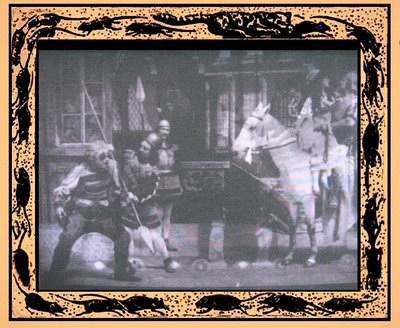
Life Without Soul (1915) was the
second film adaption of Mary Shelley's novel. This American film directed by Joseph W.
Smiley and written by Jesse J. Goldburg, received good reviews after it's release.Though it does not completely depict
Shelley’s tale, the film does contain many of its elements. It this version of
the tale a scientist name Victor Frawley creates a life giving formula. Taking
a break from his labors Frawley falls to sleep while reading Mary Shelley’s
novel Frankenstein.
The story
continues in Europe were Frawley and his friend assume the roles from the novel.
Frawley, now in the role of Victor Frankenstein uses his newly created elixir to bring a statue to life. The monster demands a mate.Frawley/Frankenstein agrees to comply but when
he breaks his promise the monster kills Victor’s sister, his best
friend Henry Cleval and then finally murders his bride on their wedding night. Frawley/Frankenstein
final traps the monster in a cave where Frawley/Frankenstein manages to blow up
the cave with dynamite thus trapping the monster within the cave forever.Frawley/Frankenstein then dies from
exhaustion, it is at that point that Frawley wakes up and then destroys his elixir.
With a run time of 70 minutes Life Without Soul (1915) was
the first feature length version of Frankenstein. Initially releasedby the Ocean Photoplays company in
November 1915, the film was later rereleased in new footage by Raver Film
Corporation in March 1916. At this time there are no copies of either version
of this film known to exist.
IL mostro di Frankenstein (1921) also known as “The
Monster of Frankenstein”was the last silent Frankenstein film.
This version of the tale was directed by Eugenio Testa and written by Giovanni
Drovetti , starring Linda Albertini, Luciano Albertini and Umberto Guarracino. IL mostro di Frankenstein, the first European
version of the Frankenstein story was produced in Italy with financial backing
from Germany. Severely cut by Italian censors before its release the film was
only 39 minutes in length. Very little is known about this film save a few
posters and stills, in fact it is rarely mentioned in most horror film history
books and websites. IL mostro di Frankenstein is considered lost at this
time.
What was the first “real” horror film ever made? Well the
answer to that question, will depend on your definition of what a horror film
is.The Execution of Mary
Stuart, which depicts the beheading of Mary, Queen of Scots
was produced by American inventor Thomas Edison in 1895. Only 18 seconds in
length, it is considered by some film historians to be the first horror film
although it would be better defined as a “trick film”. A trick film is a short
film that uses trick photography rather than plot as the driving force of the
film. Trick films were quite common in the early years of film production. The
Execution of Mary Stuart is the believed to be the first film in
history to use trained actors as well as the first use of editing for the
purpose of special effects. If you watch closely you can catch the cut where
the actresses is replaced with the mannequin just before the executioner's ax goes
down.
Le
Manoir de Diable (House of the Devil also titled The HauntedCastle) a French film made by Georges
Melies in France
in 1896 is considered by some to be the first horror movie. Méliès an illusionist turned filmmaker is most noted for his film A
Trip to the Moon (1902) which was based loosely on Jules Verne's From the Earth to the Moon and H. G. Wells'The First Men in the Moon. It is worth mentioning that A Trip to the Moonis the first known science fiction film ever produced. Although crude by today's standardsit was quite impressive in its day. You can view A Trip to the Moon using the this link: http://www.youtube.com/watch?feature=player_detailpage&v=7JDaOOw0MEE Méliès is also credited for being one of the first
filmmakers to use, time-lapse photography, multiple exposures, dissolves, and
hand-painted color.
Le
Manoir de Diable (House of the Devil) contains many of the elements
that would later be used in other horror films which would include skeletons,
ghosts, witches, and a large flying bat which flies into a medieval castle at
the beginning of the movie. The bat changes into Mephistopheles (played by Georges
Méliès) who then produces a colander and an assistant. Together the two then prepare
a potion in a colander and from its bubbling contents a young beautiful woman
emerges. They vanish from the room as to young cavaliers enter. The assistant
taunts the two cavaliers by poking them in their backs with a pitchfork and
then vanishing only to reappear in a different part of the room. One of the
cavaliers flees and the other is bedazzled with vanishing furniture and a
skeleton that suddenly appears out of thin air. As the cavalier attacks the
skeleton with a sword the skeleton turns into a bat and then seconds later
turns into theMephistopheles.
TheMephistopheles then
conjures up four ghost who then surround and attack the lone cavalier. The cavalier
manages to fight of the ghost the woman from the colander returns to the room
the Mephistopheles turns the woman in to and old hag. The hag is then turned in
to the four ghosts. The second cavalier returns and then suddenly retreats
again. The ghost then disappears and the cavalier remove a crucifix from the
wall and seeing the crucifix the Mephistopheles vanishes. The film which was just over 3
minutes in length is a short demonstration for Méliès genius and considered by
some to be the first true horror film ever made.
Four Ghost attacking a cavlier in Le Manoir de Diable (House of the Devil
The link to Le Manoir de Diable (House of the Devil):
It is important to note that whenThe Execution of Mary Stuart and Le Manoir de Diable (House of the
Devil)were produced that
motion pictures were considered more of a novelty than a vehicle for telling a
narrative story. Longer films with narrative storylines would not appear into
the early 1900s.
The French film, Esmeralda (1905)whichwas directed by Alice Guy-Blaché and Victorin-Hippolyte
Jasset, could be considered to be the first true narrative horror film. Esmeralda,
is a short film based on the novel The
Hunchback of Notre Dame. Released in 1906 it was only 10 min. in length,Esmeralda is the oldest
known film adaptation of the novel The
Hunchback of Notre Dame.Very little
is known about this film, sadly, no copies of the film are known to exist at
this time.
While there are many
film historians do consider Esmeraldato be the first true
horror narrative, it should be pointed out that there are those who do not
consider The
Hunchback of Notre Dameto be a horror story since it is void of any
supernatural elements in the storyline, which is of course a key ingredient used in most horror stories. Of course the same can be said for Phantom of the Opera, which is also considered to be one of best
horror films produced during the silent era.
Not only is Alice Guy credited with making the first horror
narrative, she is also credited as being the world's first female director. While
working as a secretary for Gaumont Chronophotographe she convinced the owner of
the company, Leon Gaumont to let her try her hand at film production.He agreed and as a result Guy, at the age of
21, made her directorial debut in 1896. Her film, La Fée aux Choux (The Cabbage
Fairy) is believed to be the first narrative film in history. However
this claim is hotly debate by film historians.The controversy seems to stem from the date involve with the production.
The Gaumont Film Company was formed in 1897 after Leon Gaumont had seen Guy’s
La Fée aux Choux (The Cabbage
Fairy)that he decided to from the Gaumont
Film Company. Since it was the La Fée aux Choux (The Cabbage Fairy)
that motivated Gaumont to start his production company it stands to reason the
film would predate the form of the company. What is unclear is just how much
time there was between the production of La Fée aux Choux (The Cabbage Fairy)
and the founding of Gaumont Film Company. There are historical documents that
clearly prove thatthe Gaumont Film
Company was formed in 1897 however there is not any source to indicate exactly
whenLaFée aux Choux (The Cabbage Fairy)was finished. Also adding to the
confusion is the fact the Guy reshoot La Fée aux Choux (The Cabbage Fairy) in
1900. Until a dated copy is found or other dccumention clearly attesting to the
dates the question of who produced the first narrative film will remain a
mystery.